Classes have ended and exams are approaching. This time, it feels different — it’s not just about tests or summer holidays.
You’re standing at a point where you must choose a stream and subjects — decisions that quietly shape your future studies, career, and work ahead.
If this feels confusing or overwhelming, it’s important to know this: it’s not because you are not capable. It’s largely because of how the human mind naturally thinks about the future.
There is a psychological explanation for why career decisions feel unclear at this stage — and understanding it can make your thinking far more grounded and realistic.

How Distance Changes the Way We Think
Psychologists talk about something called psychological distance. Simply put, it means that:
- Things that feel far away (in time or reality) are thought about in a big-picture way.
- Things that feel close are thought about in a practical, detailed way.
This idea comes from Construal Level Theory, and more specifically from something known as temporal psychological distance — which explains how our thinking changes depending on how close or far something feels in time.
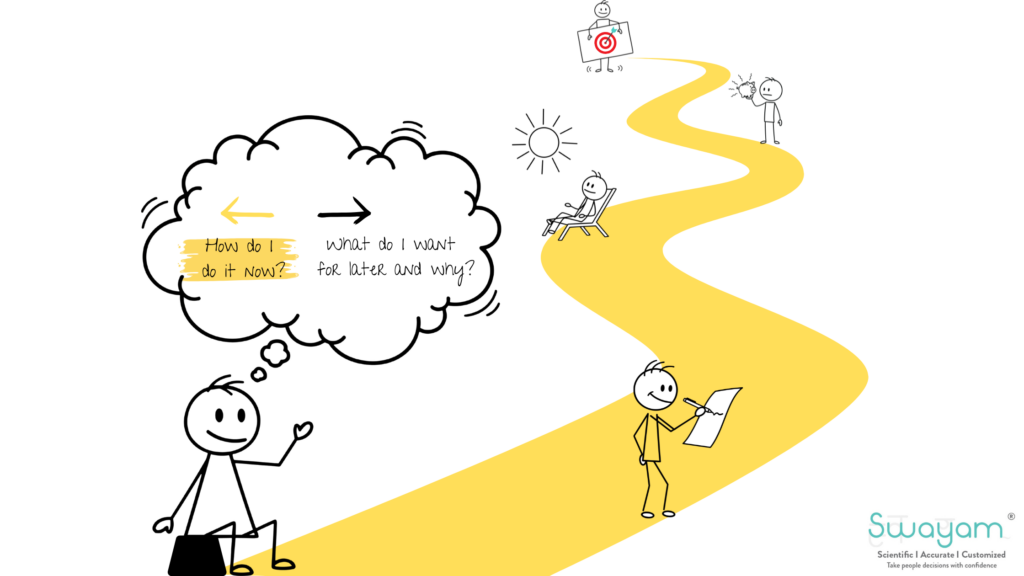
“Why should I do this?” vs “How can I do this?”
When a career decision is still far away in time, our mind naturally thinks at a high, abstract level.
For example, in Class 8 or 9, choosing a career still feels distant. At this stage, students are not imagining the daily work or the preparation involved. Instead, they think about the idea of a career.
Questions at this stage often sound like:
- Why is engineering seen as successful?
- Why is medicine respected?
- Why do people say commerce or arts are risky or safe?
These are “why” questions. They focus on meaning, reputation, income, social approval, and expectations — not on the actual process of doing the work.
Now think about Class 10 or 12, results around the corner.
Suddenly, the questions change:
- How will I crack this entrance exam?
- How many hours should I study?
- How do I get into this college?
These are “how” questions. They focus on effort, skills, preparation, and reality.
Neither way of thinking is wrong. But problems start when career decisions are made only at the “why” level and ignored at the “how” level.
Where Career Confusion Really Comes From
Many students choose careers when they are still psychologically far from actually doing the work.
At that stage, careers look like:
- Prestige
- Income
- Titles
- Social approval
But when the career comes closer, reality appears:
- Daily tasks
- Required skills
- Pressure and stress
- Long-term effort
That’s when students realise:
- “I don’t enjoy this.”
- “I’m struggling.”
- “This doesn’t feel like me.”
This mismatch isn’t a failure — it’s a perception gap.
The Missing Piece: Understanding Yourself
A career is not guesswork or copying others.
It is something you have to live with every day.
That’s why the strongest career decisions are based on:
- Your capabilities (what you can realistically do well)
- Your strengths (what comes more naturally to you)
- Your interests (what holds your attention over time)
- Your natural inclinations (how you think, feel, and behave)
The closer you get to understanding who you really are, the better your career decisions become.
Why Personality Matters More Than You Think
Your personality influences:
- How you handle pressure
- Whether you enjoy working with people or data
- How structured or flexible you prefer your work
- How you learn, decide, and solve problems
Two students can choose the same career — one may thrive, the other may feel exhausted and stuck.
The difference is not intelligence.
It is fit.
Understanding your personality and behavioural traits helps you move from vague “why” thinking to realistic “how” thinking — before it’s too late.
A Better Way to Think About Careers
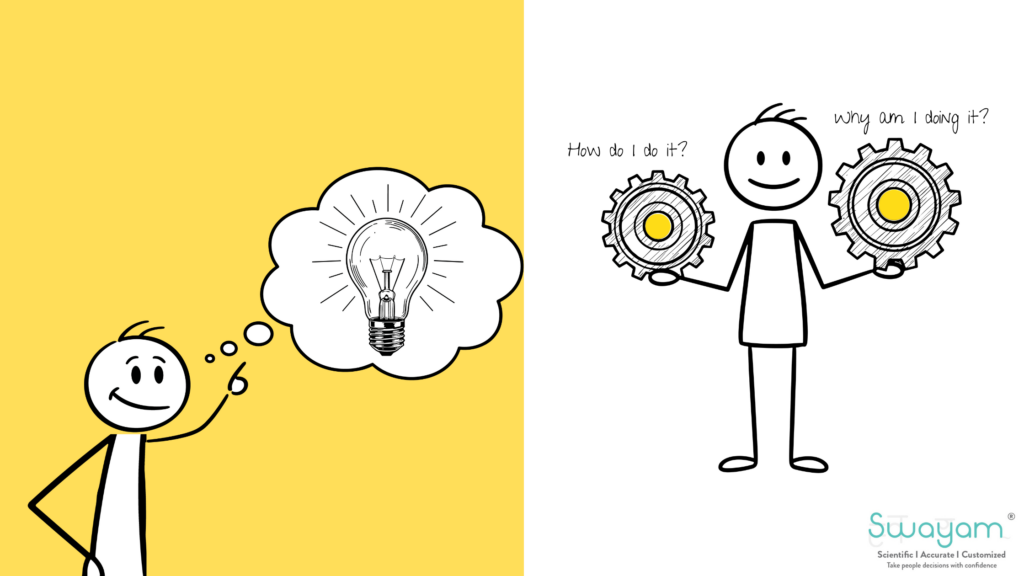
Instead of only asking:
- Why is this career good?
Also ask:
- How does this career match who I am?
- How does it use my strengths?
- How does it fit my way of thinking and working?
Careers feel clearer when decisions are made closer to reality, with a deep understanding of self.
Final Thought
Career confusion is not a weakness. It’s a sign that your mind is trying to make sense of a big decision using limited information.
When you understand how perception works — and when you understand yourself — career decisions stop being guesses. They become informed choices.
And that is where confidence truly begins.
Resources
Adler, S., & Sarstedt, M. (2021). Mapping the jungle: A bibliometric analysis of research into construal level theory. Psychology & Marketing, 38(9), 1367-1383. https://onlinelibrary.wiley.com/doi/full/10.1002/mar.21537
Trope, Y., & Liberman, N. (2010). Construal-level theory of psychological distance. Psychological review, 117(2), 440. https://pmc.ncbi.nlm.nih.gov/articles/PMC3152826/